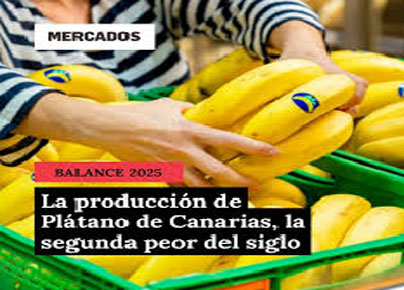
Plátano de Canarias Concludes 2025 with Second Lowest Harvest of the 21st Century
2026-02-20
The Canary Islands' banana production totalled 374.6 million kilos in 2025, a 12% decline. This marks the second-lowest harvest in the past 25 years.
Despite remaining a preferred choice among consumers and reinforcing its added value, the Canary Islands' banana sector has struggled to compete with imported bananas on the Peninsula. In 2025, consumption of imported bananas increased from 285 million kilos in 2024 to over 322 million kilos, a 4.62% increase. This increase was largely due to a decline in the domestic product.
The combined banana category has been the fastest-growing segment among non-seasonal fruits in Spain over the past two decades, driven by ongoing promotion of Plátano de Canarias and increased production. However, in years of lower harvests, this category suffers. Total banana consumption reached 628.5 million kilos, only a 1.3% increase from the previous year, while the market value rose by 20.2%. Per capita consumption stood at 13.12 kg, almost unchanged from 2024's 13.03 kg.
The combination of reduced supply and strong demand among Spanish households for locally produced bananas has led to a price revaluation at the source. The average green price generated over 468 million euros for the Canary Islands, highlighting the importance of this crop as an economic and social engine in a region highly dependent on imports. However, the sector warns of significant supply fluctuations throughout the year, which means averages should be interpreted cautiously, as their impact varies by region, producer, and time.
In 2025, the average sales price for Canary Island bananas was €2.80 per kilogram, with a price differential of over 100% between the export price and the recommended retail price (RRP). Despite this, the product remains one of the most economical options in the fruit section, especially when compared to other national or European fruits.
As 2025 comes to a close, the sector's primary focus is on stabilising and recovering marketable volumes. This is essential to minimise losses and sustain yields that support over 7,100 producers and 5,000 direct jobs. The instability in volumes favours the presence of imports on store shelves. It leads to consumer complaints about the limited availability of Protected Geographical Indication (PGI) Canary Island Bananas, even when there is an adequate supply at the origin.
Along with these challenges, European regulations impose limitations on phytosanitary tools, which do not apply to imports. This situation results in greater losses, food waste, and cost pressures, as products face rejection for aesthetic reasons, ultimately reducing yields and complicating competition.